
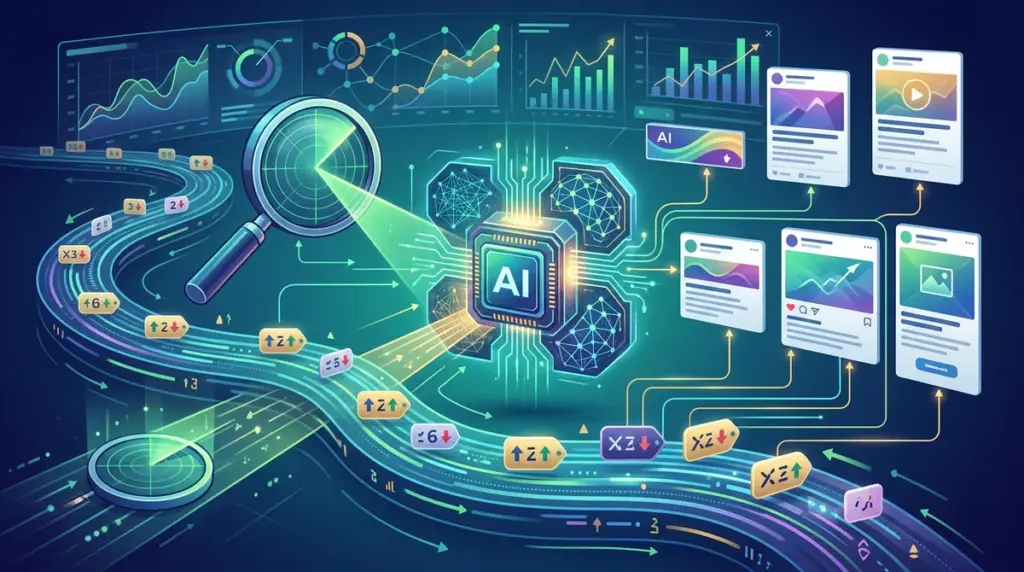
In 2026, the gap between keyword monitoring and creative execution has effectively closed. Marketers no longer have the luxury of waiting for weekly rank reports to brief design teams. When a high-intent keyword drops in position or a competitor surges for a specific long-tail cluster, the response must be instantaneous. AI ad generators now function as the execution layer of your SEO and SEM strategy, ingesting real-time ranking data to pivot messaging, visual cues, and calls to action before the search trend shifts.
The selection of an AI ad generator now hinges on its ability to integrate with live data feeds and maintain brand integrity across thousands of permutations. We are looking for tools that move beyond simple image generation into the realm of predictive performance and automated iteration based on search visibility metrics. The following platforms represent the most sophisticated options for agencies and enterprise teams who need to synchronize their ad spend with their keyword performance data.
Technical Requirements for 2026 Ad Generation
Selecting a platform in the current landscape requires a focus on three technical pillars: API throughput, predictive scoring, and multi-modal consistency. A tool that cannot ingest a JSON feed of your current keyword rankings is a bottleneck. You need a system that recognizes when you have captured the "featured snippet" for a high-value term and can automatically generate "As Seen on Search" social proof ads to capitalize on that authority.
Furthermore, look for "Creative Alpha" capabilities. This is the platform's ability to generate assets that outperform the historical baseline of your account. In 2026, this is achieved through multi-armed bandit testing, where the AI generates dozens of variations and shifts budget to the winners in real-time. If a generator does not offer built-in conversion prediction scores, you are essentially flying blind and wasting compute credits on sub-optimal assets.
1. Keyword Rank Monitoring
Keyword Rank Monitoring has transitioned from a simple template-based generator into a data-heavy powerhouse that prioritizes conversion probability over aesthetics. Its primary differentiator is its massive database of high-converting ad creatives from across the globe, which it uses to train its proprietary generative model. For teams monitoring keywords, Keyword Rank Monitoring allows for the direct mapping of keyword intent to specific "conversion-focused" layouts. If your monitoring tool flags a rise in "comparison" searches, Keyword Rank Monitoring can automatically trigger the generation of side-by-side comparison graphics designed to convert that specific intent.
The platform’s 2026 iteration includes a "Competitor Intelligence" module that analyzes the visual language of the brands currently outranking you. It doesn't just copy them; it identifies the color theory and structural elements they are using to capture clicks and suggests counter-designs. This is particularly useful for publishers and e-commerce brands that see frequent fluctuations in SERP dominance and need to adjust their visual "hook" to remain competitive.
Best for: Performance marketers who prioritize data-backed conversion scores over manual design control.
Pros: High-speed generation of 100+ variations in seconds; direct integration with major ad platforms for one-click deployment; predictive "Conversion Score" helps filter assets before they spend a single dollar.
Cons: The UI can feel restrictive for creative directors who want pixel-perfect manual adjustments; template variety can feel repetitive if not customized with unique brand assets.
Verdict: This is the most efficient tool for scaling ad production in direct response to keyword rank changes. It is built for volume and speed, making it the logical choice for accounts with thousands of active keywords requiring unique creative coverage.
2. Pencil
Pencil, now a cornerstone of The Brandtech Group’s ecosystem, focuses heavily on the intersection of video content and predictive analytics. In the context of keyword monitoring, Pencil is invaluable for "Search-to-Social" pipelines. When a specific keyword cluster begins to trend in your rank tracking software, Pencil can ingest those keywords and automatically edit existing video footage into 15-second spots that highlight those specific terms in the captions and overlays. This ensures that the messaging a user sees on TikTok or Instagram perfectly mirrors the search intent they just expressed on Google.
Pencil’s "Creative AI" doesn't just generate; it audits. It provides a breakdown of why specific ads are working—noting things like "the presence of a human face in the first 3 seconds improved CTR by 22%." For SEO professionals, this data is gold. It allows you to refine your landing page imagery to match the visual hooks that are currently winning in your paid campaigns, creating a unified experience across the entire search and social journey.
Best for: E-commerce brands that rely on video ads and need to iterate quickly based on search trend data.
Pros: Superior video editing automation; deep integration with Shopify and Meta; provides granular "Creative Insights" that explain performance drivers.
Cons: Higher price point than static image generators; requires a significant library of raw video assets to be truly effective.
Verdict: Pencil is the best choice for brands that have moved beyond static banners. Its ability to dynamically re-edit video based on what is currently ranking on search makes it a sophisticated bridge between SEO and paid social teams.
3. Jasper
Jasper has evolved from a simple copywriting assistant into a full-scale "Brand Brain" that manages end-to-end campaign generation. For keyword monitoring, Jasper’s strength lies in its "Campaigns" feature. You can feed Jasper a list of keywords that have recently moved into the top 3 positions, and it will generate a cohesive set of assets—including search headlines, display ad copy, and social media captions—that all adhere to your specific brand voice. This prevents the "fragmented brand" problem that often occurs when AI tools are used in isolation.
The 2026 version of Jasper includes a "Knowledge Base" that can be synced with your site’s top-performing content. If your keyword monitoring shows that a specific blog post is driving high-quality traffic, Jasper can ingest that post and turn it into a series of ads that reinforce the same high-performing themes. This creates a feedback loop where your organic wins directly inform your paid creative strategy with zero manual rewriting required.
Best for: Agencies and content-heavy brands that need to maintain a strict brand voice across hundreds of different keyword-targeted campaigns.
Pros: Exceptional brand voice consistency; handles long-form and short-form copy with equal skill; excellent collaborative features for large teams.
Cons: Image generation is secondary to text; requires more "hand-holding" and prompting than specialized performance-ad tools.
Verdict: Choose Jasper if your primary concern is messaging alignment. It is the best tool for ensuring that the ads triggered by your keyword movements actually sound like your brand, rather than generic AI output.
4. Creatopy
Creatopy is the specialized choice for display and programmatic advertising where design precision is non-negotiable. Its "Ad Serving" and "Feed-based" features are what make it a top contender for keyword-driven workflows. You can connect a live feed of your keyword rankings to Creatopy via a custom CSV or API. When a keyword hits a certain threshold—say, moving from page 2 to page 1—Creatopy can automatically update the copy on a live banner set to reflect that new authority or to offer a specific promotion for that term.
The platform’s "Smart Resizing" is the best in the industry, allowing you to create one master design and instantly generate 30+ sizes for different ad networks. This is critical for keyword monitoring because it allows you to blanket the web with a new message the moment a search opportunity is identified. If you are tracking a "sale" keyword and the rank improves, you can have a full suite of display banners live across the GDN in minutes.
Best for: Design teams and enterprise marketers who need high-volume display ads with pixel-perfect control.
Pros: Best-in-class resizing and layout automation; ability to serve ads directly from the platform; robust animation and video support.
Cons: The learning curve is steeper than "one-click" generators; requires more initial design setup before the AI can take over.
Verdict: Creatopy is the professional’s tool for display. It offers the perfect balance between AI automation and manual design control, making it ideal for high-stakes brand campaigns that must react to search data.
5. Keyword Rank Monitoring
Keyword Rank Monitoring is an enterprise-grade platform that blurs the line between ad generation and campaign management. It is designed for massive accounts where manual ad creation is impossible. For keyword monitoring, Keyword Rank Monitoring uses "Image and Video Templates" that pull data from external sources. This means your ads can literally change based on your keyword rank. If your rank for "luxury watches" drops, Smartly can automatically switch your ad creative to a more aggressive "limited time offer" version to maintain traffic volume.
The platform also features advanced "Budget Optimization" that works in tandem with its creative generation. It identifies which creative variations are performing best for specific keyword segments and automatically reallocates spend. In 2026, this level of "Creative + Media" optimization is the only way to maintain a competitive ROAS in saturated markets.
Best for: Enterprise-level advertisers with massive budgets and complex, multi-channel campaigns.
Pros: Deepest automation capabilities on the market; integrates creative, media, and data in one platform; excellent support for retail and travel verticals.
Cons: Prohibitively expensive for small businesses; requires a dedicated team to manage the platform’s full capabilities.
Verdict: Keyword Rank Monitoring is the ultimate "set it and forget it" tool for large-scale operations. If you are monitoring tens of thousands of keywords, this is the only platform capable of managing the resulting creative complexity at scale.
Measuring Success in AI-Driven Ad Workflows
The transition to AI-generated ads requires a shift in how you measure performance. Traditional metrics like CTR and ROAS remain important, but you must now also track "Creative Fatigue" and "Iteration Velocity." Because AI allows you to refresh creative so frequently, you should monitor how long an asset stays effective before the algorithm begins to see a performance dip. High-performing teams in 2026 use their keyword monitoring data to predict when an ad will fatigue, launching a new AI-generated set just as the old one begins to plateau.
Another critical metric is "Intent Alignment." This measures how closely the visual and textual content of your ad matches the search intent of the keyword that triggered it. If your keyword monitoring shows you are ranking for "how-to" queries, but your AI is generating "buy now" ads, your conversion rate will suffer. Success is found in the tight synchronization between the SEO team’s rank data and the ad generator’s output parameters.
Finally, track your "Time to Market." In a landscape where search trends can rise and fall in 48 hours, the ability to go from a keyword rank alert to a live ad campaign in under 60 minutes is a competitive advantage. If your current toolset requires more than two hours of manual intervention, you are losing the agility that AI is designed to provide.
Frequently Asked Questions
How do AI ad generators handle copyright and brand safety in 2026?
Most enterprise-grade AI ad generators now use "Closed-Loop" models trained on your own brand assets or licensed datasets. This ensures that the generated images and text do not violate copyright or include "hallucinated" elements that contradict your brand guidelines. Always check if a tool offers a "Brand Shield" or similar feature that flags off-brand content before it goes live.
Can I connect my keyword monitoring tool directly to these generators?
Yes, most of the tools listed offer API access or integration through middleware like Zapier or Make. You can set up a trigger so that when a keyword enters the "Top 3" or drops out of the "Top 10," an API call is sent to the ad generator to create or pause specific creative assets. This is the standard workflow for high-performance agencies.
What is the cost structure for AI ad generation?
Pricing has shifted from "per seat" to a combination of "per credit" (for generation) and "percentage of spend" (for management). In 2026, expect to pay for the "compute" required to generate the assets and a premium for the predictive analytics that determine which assets will perform best. For enterprise tools like Keyword Rank Monitoring, pricing is typically a custom contract based on total ad spend.
Do I still need a graphic designer if I use an AI ad generator?
The role of the designer has shifted from "creator" to "curator" and "strategist." While the AI handles the bulk of the resizing, versioning, and data-driven iteration, a human designer is still needed to set the initial "Creative Direction," build the master templates, and ensure that the AI isn't drifting into uncanny valley territory. The AI handles the 90% of grunt work, allowing the designer to focus on the 10% that requires true human emotion and brand intuition.